
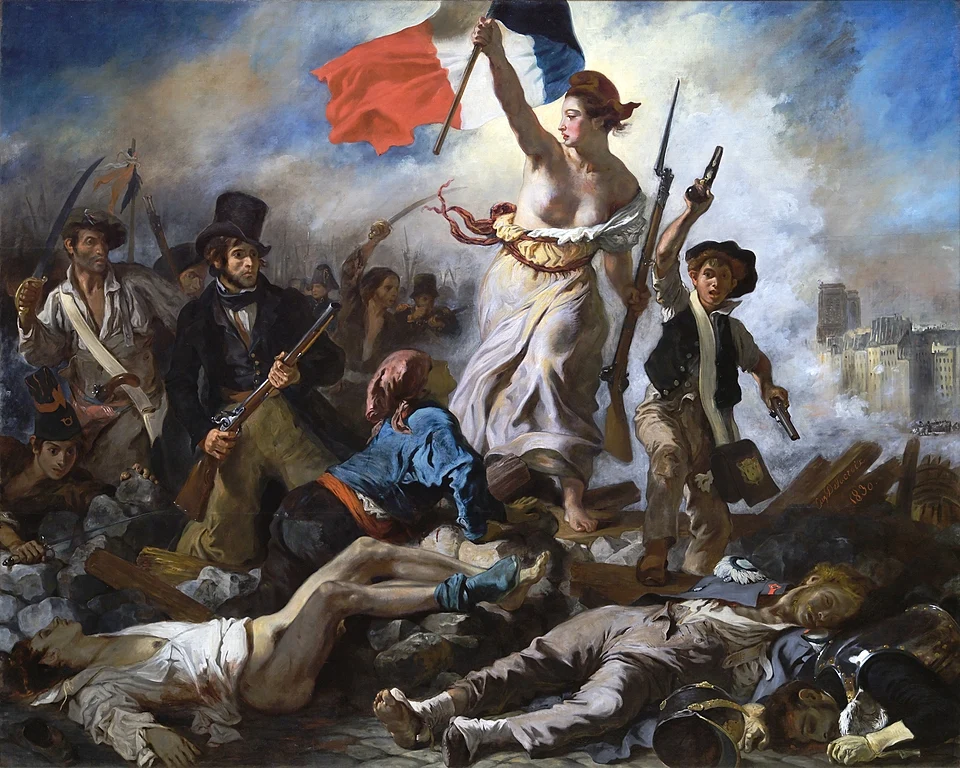
Eugène Delacroix’s Liberty Leading the People (La Liberté guidant le peuple), painted in Paris in 1830 to commemorate the July Revolution, stands as one of Romanticism’s most powerful history paintings. Executed in oil on canvas, its iconic female figure “Liberty” strides forward over the barricades with the French tricolor in one hand and a musket in the other, embodying both emotional fervor and political resolve.
Historical Background and Staging the Revolution
At the end of July 1830, King Charles X’s harsh censorship and repressive ordinances triggered what became known as the “Three Glorious Days” (July 27–29). Workers and middle‑class citizens erected barricades in Paris streets and took up arms against royal troops. Inspired by the energy and determination he witnessed, Delacroix began preliminary sketches in September and completed the full composition between October and December. When it was exhibited at the 1831 Salon, the painting’s fusion of political drama and high art sent shockwaves through the contemporary art world.
Dramatic Rhythm of Composition and Arrangement of Figures
Delacroix’s scene, laid out along a horizontal axis, places the goddess‑like Liberty at its apex, forming a commanding triangular composition. At the painting’s base, fallen and wounded figures create a somber foundation, while Liberty—her tricolor flagstaff raised—soars skyward. To her right, a laborer, and to her left, a young student (modeled after Delacroix’s acquaintance, the poet Évariste de Peyrol), represent different social strata and bring the viewer into the uprising. Smoky silhouettes and crumbling barricades in the background reinforce the forward momentum of revolution, as compositional lines guide the eye from the tumult below up toward Liberty herself.
Symbolism and Formal Innovation
• Icon of Liberty: The bare‑chested female figure bearing the tricolor unites republican ideals of resistance with heroic imagery drawn from classical mythology.
• Social Mosaic: The juxtaposition of worker, bourgeois, and youthful revolutionary underscores popular unity and multi‑layered defiance.
• Color and Light: Stormy midnight blues and blood‑red tones in the sky evoke struggle and resolve, while bright white highlights symbolize sparks of hope.
• Dynamism and Brushwork: Delacroix’s rapid, emphatic brushstrokes convey the chaos and excitement of battle, elevating Romantic expressiveness to its height.
First Exhibition and Critical Reception
First shown at the 1831 Salon, Liberty Leading the People was deemed “dangerous” by some critics alarmed at its defiant political message. Yet it was celebrated by popular audiences as a stirring emblem of revolution and quickly cemented Delacroix’s reputation as a master of history painting. Acquired by the French state in 1874 and placed in the Louvre, the painting has since maintained its status as a universal symbol of revolution and freedom.
Credits
Title: La Liberté guidant le peuple
Artist: Eugène Delacroix
Year: 1830
Movement: Romanticism
Dimensions: 260 × 325 cm
Medium: Oil on canvas
Location: Musée du Louvre