
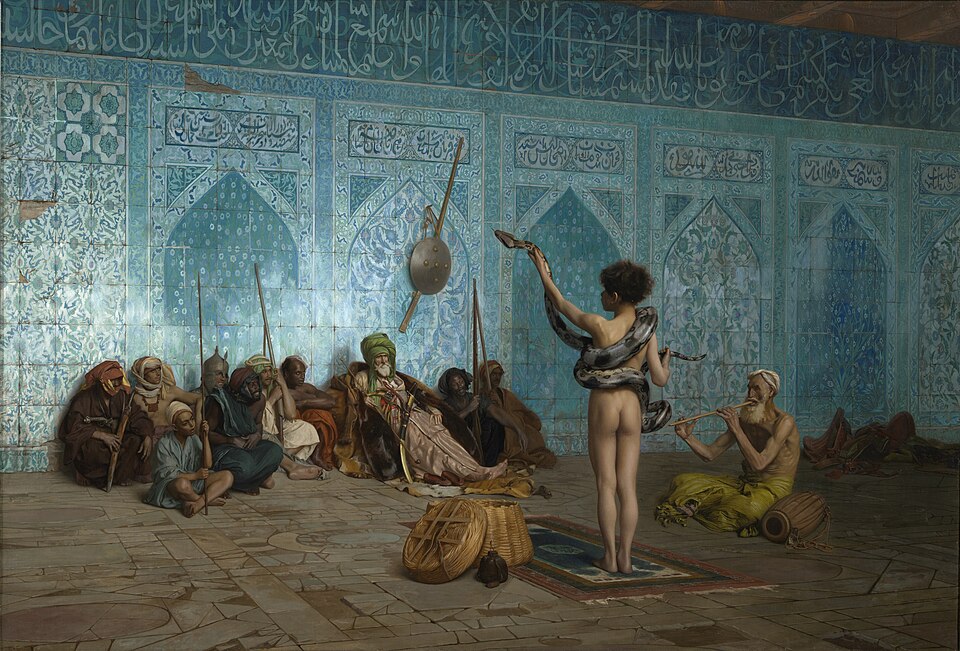
Jean‑Léon Gérôme’s The Snake Charmer (Fr. Le Charmeur de serpents) is one of the most striking examples of the Orientalist movement that gained prominence in France during the late 19th century. Combining a surreal level of detail with an exotic scene stretching from the West to the Middle East, it is not merely an aesthetic object but also a visual representation of imperialism, cultural perspective, and the Western gaze toward the “Other.”
The Birth of the Orientalist Scene
In the 1860s, Gérôme was profoundly influenced by his travels through North Africa, Ottoman Egypt, and Istanbul. These journeys inspired him to paint the dusty, winding streets, the dim interiors of harems, and the daily rituals of street performers—all elements of the “exotic East” as imagined by the Western eye. Completed around 1879, The Snake Charmer can be considered the pinnacle of Orientalist painting in both technique and theme within the French academic tradition.
Rhythmic Precision in Composition
In the painting, the upward motion of the snake rising from the back of a young Black boy is visually counterbalanced by the semi-circular formation of female and male spectators, likely imagined as members of a harem. The vertical presence of the snake contrasts with the horizontal eye-line of the seated onlookers, creating a powerful rhythmic tension. Mosaic patterns on the floor and carved motifs on the walls interlace the figures into a visual web, reinforcing both the stillness and fluidity of the scene.
Symbolism and the Intersection of Realism
• The painting symbolizes the West’s fascination with and desire to dominate the “Other.” The passive, almost indifferent expressions of the spectators make it difficult for the viewer to emotionally connect, enhancing the image’s alienating effect.
• The cold, porcelain-like sheen of the lighting and the minutely rendered skin textures reveal Gérôme’s near-photographic realism.
• The contrast between warm earthen tones and the snake’s pale blue-green body intensifies the emotional charge of the exotic narrative. Meanwhile, the patterned tiles on the wall serve as both ornament and icy backdrop.
First Exhibition
The Snake Charmer was sold in 1880 through Goupil & Cie to Albert Spencer and received wide attention at the 1893 World’s Columbian Exposition in Chicago. In the 20th century, it was housed in the Metropolitan Museum of Art (New York) before being acquired in 1955 by the Sterling and Francine Clark Art Institute in Williamstown, Massachusetts, where it remains today. Its selection as the cover image of Edward Said’s groundbreaking 1978 book Orientalism turned the painting into an iconic symbol in the discourse surrounding Orientalist art.
Credits
Name: Le Charmeur de serpents
Artist: Jean‑Léon Gérôme
Year: 1879
Movement: Orientalism
Dimensions: 82.2 × 121 cm
Meidum: Oil on canvas
Location: Sterling and Francine Clark Art Institute